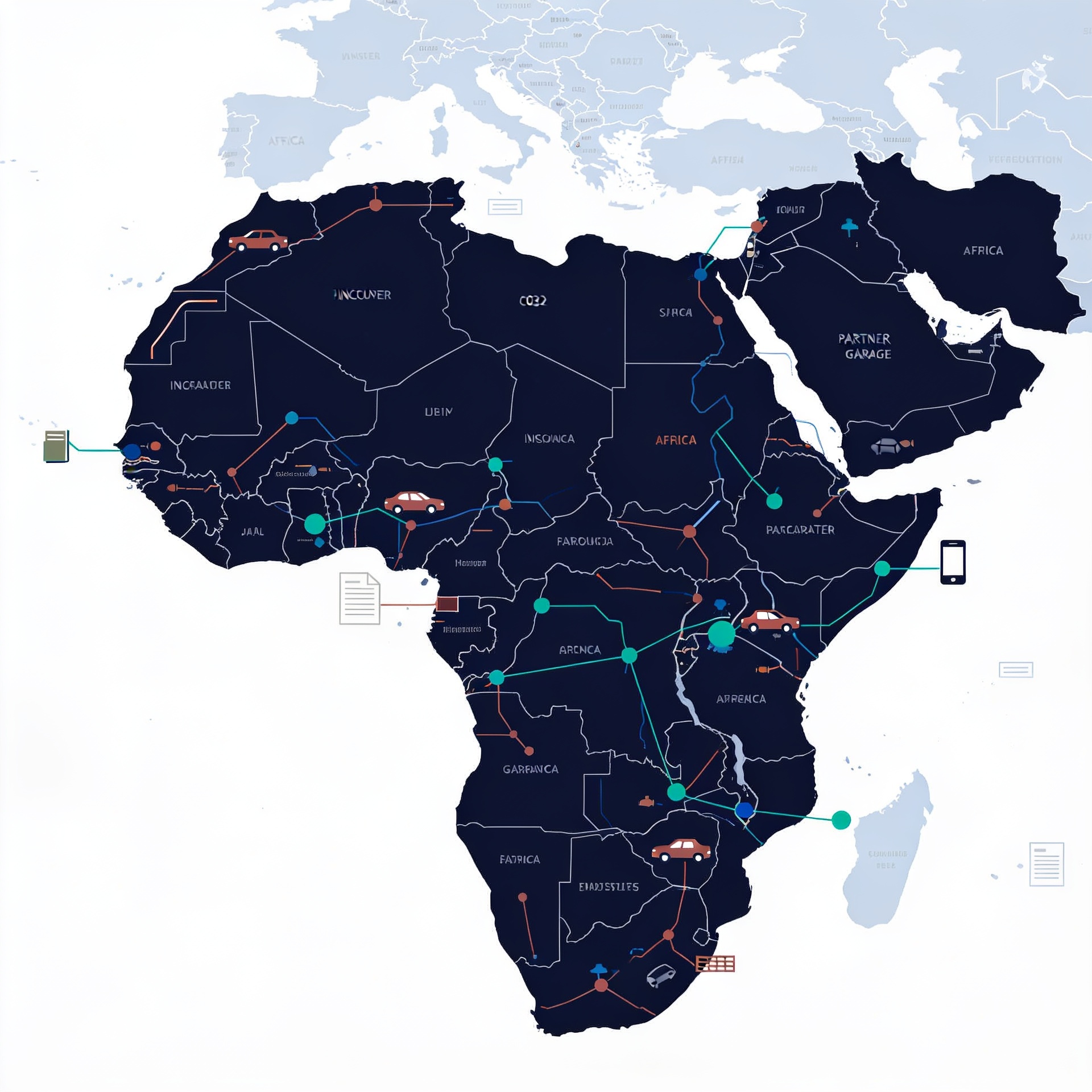
An approved or partner garage is a repair shop that an insurer or broker has vetted, contracted and integrated into its claims workflow, so repairs after an accident follow agreed pricing, quality and reporting standards. Insurer partner garages across Africa matter because they give insurers a direct way to control repair costs, cut settlement delays and reduce fraud risk, three pressures that weigh heavily on motor loss ratios in CIMA-zone countries, Morocco, Nigeria and Ghana. The sections below look at how these networks are built, what governs them, and what digitalization changes.
What is an approved/partner garage and why do African insurers rely on insurer partner garages across Africa?
An approved garage differs from an ordinary repairer on three points: a pre-negotiated pricing scale for parts and labor, a technical and quality standard the garage commits to, and an obligation to report back to the insurer or broker (quotes, invoices, photos) in a defined format and timeframe. A random garage chosen by the insured offers none of these guarantees.
A contractual and technical relationship, not just a referral list
The relationship is formalized through a service agreement, not a simple recommendation. It sets repair-time commitments, warranty terms, and often the volume of claims the garage can expect in exchange for preferential rates.
Why this matters for African insurers specifically
The pressure is structural. According to a FINACTU analysis of FANAF data, CIMA-zone insurers spent FCFA 91 billion compensating road accident victims in 2017, up from FCFA 74 billion in 2013, a 22% rise in claims burden against only 16% premium growth over the same period (FINACTU). The same analysis notes that road accidents kill around 45,000 people per year in the CIMA zone, a toll higher than in all of Europe despite the zone holding less than 1% of the world's vehicle fleet against Europe's 19%. A structured garage network is one of the few levers insurers control directly inside this cost trajectory.
How do insurers select and manage their approved garage network?
Selection is usually built around five criteria: technical certification, agreed pricing, turnaround-time commitments, geographic coverage relative to the insured population, and the garage's ability to work digitally.
| Selection criterion | What it controls |
|---|---|
| Technical certification | Repair quality and warranty compliance |
| Pre-agreed pricing scales | Cost of parts and labor per claim |
| Turnaround-time commitment | Claim cycle time and customer experience |
| Geographic coverage | Network density versus insured population |
| Digital integration capability | Speed and traceability of quotes, invoices, photos |
Governance and pilot mechanisms
Managing the network day to day usually means periodic performance scorecards (repair time, rework rate, cost variance against the agreed scale) and volume allocation that rewards garages meeting those targets. Without this ongoing governance, an approved-garage list tends to decay into a static directory that no longer reflects actual repair quality or price discipline, a pattern flagged for the Moroccan market in a 2023 FAIR/SCR Academy study of the auto branch, which describes insurers' approved-garage networks there as limited and poorly structured, constraining cost control and vehicle-routing efficiency.
What is the real impact of an approved garage network on average claim cost?
The direct effect is price discipline: repair costs follow a negotiated scale instead of an open-market quote, and volume commitments give insurers leverage to negotiate that scale down. The indirect effect is cycle time: a garage used to the insurer's process produces a usable quote faster, which shortens the whole claims file.
The counterfactual is visible in markets where networks remain informal. The FAIR/SCR Academy study on Morocco's auto branch points to networks that are not well structured as a factor limiting insurers' ability to steer repair volumes and hold costs down. In the CIMA zone, the gap between premium growth (16%) and claims-cost growth (22%) over 2013-2017 reported by FINACTU illustrates the scale of the pressure a disciplined network is meant to offset, even though that specific figure reflects a historical FANAF dataset and should be read as directional rather than current.
How does digitalization change the insurer-garage relationship?
Digitalization replaces paper quotes, loose photo attachments and manual follow-up with a shared, traceable workflow. Garages submit quotes and invoices through a platform instead of email or WhatsApp threads, experts validate remotely rather than traveling to every site, and the insurer or broker sees the file status in real time.
Certified photography is the part of this shift most directly tied to cost and fraud control. Guided capture with geolocation and timestamp, as implemented by YourSmartFlow through its technology partner WeProov, produces before-and-after images that are harder to substitute or edit than an ordinary phone photo attached to an email. Once a claim file is complete, settlement can even be triggered automatically via API, removing a manual step that otherwise adds days to the process. This is the same logic described in our pillar guide on Approved Repairer Networks for Auto Insurers in Africa: From Discount Deals to Digital Pipelines.
What are the country-specific specifics: CIMA zone, Morocco, Nigeria, Ghana?
Regulatory pressure on claims handling differs by market, and it shapes how much weight falls on the garage network.
| Market | Regulatory or market context | Garage network note |
|---|---|---|
| CIMA zone | Article 231 sets a 6-month deadline from the accident date for a compensation offer; Article 233 imposes a 5%-per-month penalty for late offers (per CIMA Code reform reported by 221Assurances, in force since August 2023). Insurance on credit was banned CIMA-wide from 11 April 2025. | Tight deadlines increase pressure on repair turnaround inside the network. |
| Morocco | ACAPS launched a digital platform in September 2026 to process policyholder complaints, reflecting regulatory push toward digitalized claims processes (Financial Afrik). | A 2023 FAIR/SCR Academy study found approved-garage networks limited and poorly structured at the time. |
| Nigeria | No specific NAICOM rule on approved-garage network structure was identified in this review; insurers largely build and manage their own lists. | Network discipline depends on individual insurer governance rather than a uniform regulatory template. |
| Ghana | NIC Ghana reports GH¢3.6 billion paid in claims across all insurance lines in 2024, roughly GH¢299 million per month; NIC also operates a Client Rescue Fund as a policyholder safety net. | The GH¢3.6 billion figure covers life and non-life combined, not motor alone, so it should be read as market-wide context rather than a garage-specific benchmark. |
How does an approved garage network help fight auto claims fraud?
Fraud in motor claims typically takes one of two forms inside a garage relationship: inflated or duplicated quotes, and photos that do not actually match the vehicle or the damage declared. Globally, fraud is estimated to affect close to 10% of claims filed in some markets, and close to 20% of auto claims declarations in China, according to Atlas Magazine; these figures are global benchmarks, not African-specific data, but they illustrate the scale of exposure an unmonitored process can carry.
An approved network narrows this exposure structurally, because garages operate under a contract with defined pricing and reporting obligations. Digitalization narrows it further: certified photos that are geolocated and timestamped, as implemented through YourSmartFlow's partnership with WeProov, make it harder to reuse an old image or submit a photo taken outside the claimed location or date. Combined with an expert's remote validation of the quote before approval, this closes much of the gap that a purely paper-based process leaves open.
What is the ROI for an insurer or broker who structures its garage network with a digital platform?
Structuring a garage network on a digital platform affects two sides of the claims equation at once: the cost per claim and the speed of the claims cycle. YourSmartFlow reports having optimized more than 250,000 auto claims in 2025 across more than 50 insurer and broker clients in five African countries, with an average go-live of four weeks, an estimated 10 to 15% reduction in claims burden, and first-year ROI for clients. These are company-reported figures rather than independently audited statistics, but they indicate the order of magnitude insurers can expect when quotes, invoices, certified photos and settlement triggers move from scattered paper and messaging channels into one connected workflow linking the insured, the broker or insurer, the expert and the garage.
The practical case for this kind of platform is not abstract. A connected network shortens the time between damage assessment and settlement, applies pricing discipline consistently across every garage in the network, and leaves a traceable record that supports both fraud control and regulatory reporting, three outcomes directly tied to loss ratio management rather than customer experience alone.
Across CIMA-zone countries, Morocco, Nigeria and Ghana, the regulatory and market pressures differ, but the underlying lever is the same: a garage network that is selected deliberately, governed with ongoing performance data, and connected digitally performs differently than a static list of repairers. For insurers and brokers weighing where to focus claims transformation efforts first, the garage network is one of the few points in the claims chain where better governance translates almost directly into a better loss ratio.
Frequently asked questions
What differentiates an 'approved garage' from an ordinary garage for a motor claim?
An approved garage operates under a contract with the insurer or broker that fixes pricing for parts and labor, sets a quality and warranty standard, and requires structured reporting of quotes, invoices and photos. An ordinary garage chosen independently by the insured offers no such pre-agreed pricing or reporting discipline. This is why approved networks are built around governance, not just a list of contact details.
How does an insurer or broker choose which garages to include in its approved network?
Selection typically weighs technical certification, agreed pricing scales, turnaround-time commitments, geographic coverage relative to the insured population, and the garage's capacity to work digitally. These criteria are then monitored over time through performance scorecards rather than checked only once at onboarding. A garage that no longer meets its commitments can lose volume allocation or be removed from the network.
Does an approved garage network really reduce average claim cost, and by how much?
A disciplined network reduces cost by applying a negotiated pricing scale instead of an open-market quote and by shortening the claims cycle, which limits ancillary costs such as extended vehicle downtime. The exact scale of the effect varies by market; CIMA-zone data from FINACTU shows claims costs rising faster than premiums over 2013-2017, a gap a well-managed network is meant to narrow. Platforms that digitalize the process, such as YourSmartFlow, report an estimated 10 to 15% reduction in claims burden for their clients, a company-reported figure rather than an independently audited one.
How do certified photos with timestamp and geolocation help prevent fraud in garage quotes and invoices?
A geolocated, timestamped photo is harder to reuse from an earlier claim or to substitute for an image taken somewhere else, which closes a common fraud pathway in garage-submitted documentation. Guided capture, as implemented by YourSmartFlow through its technology partner WeProov, also standardizes the angles and framing experts need to validate damage remotely. Combined with expert review before approval, this reduces reliance on trust alone when assessing a quote.
What regulatory obligations shape repair timelines and claims handling in these markets?
In the CIMA zone, Article 231 of the CIMA Code sets a 6-month deadline from the accident date for insurers to present a compensation offer, and Article 233 imposes a 5%-per-month penalty for late offers, per a reform reported by 221Assurances. Morocco's regulator ACAPS has pushed toward digitalized claims-related processes, including a complaints platform launched in 2026. Specific NAICOM rules on garage-network structure for Nigeria were not identified in this review, and Ghana's NIC tracks claims payment reliability market-wide, including through its Client Rescue Fund, though its published claims figures cover all insurance lines rather than motor alone.
How can an insurer digitalize the relationship between insurer, expert and garage without disrupting the insured's experience?
The insured keeps a simple, familiar entry point, such as web, app or WhatsApp, to declare a claim and track its progress, while the complexity of coordinating the expert and the garage happens behind that interface. A shared platform lets the garage submit quotes, invoices and certified photos directly, and the expert validate remotely, instead of routing everything through phone calls and separate email threads. This is the model YourSmartFlow applies across its insurer and broker clients, connecting all four parties of a claim in real time.