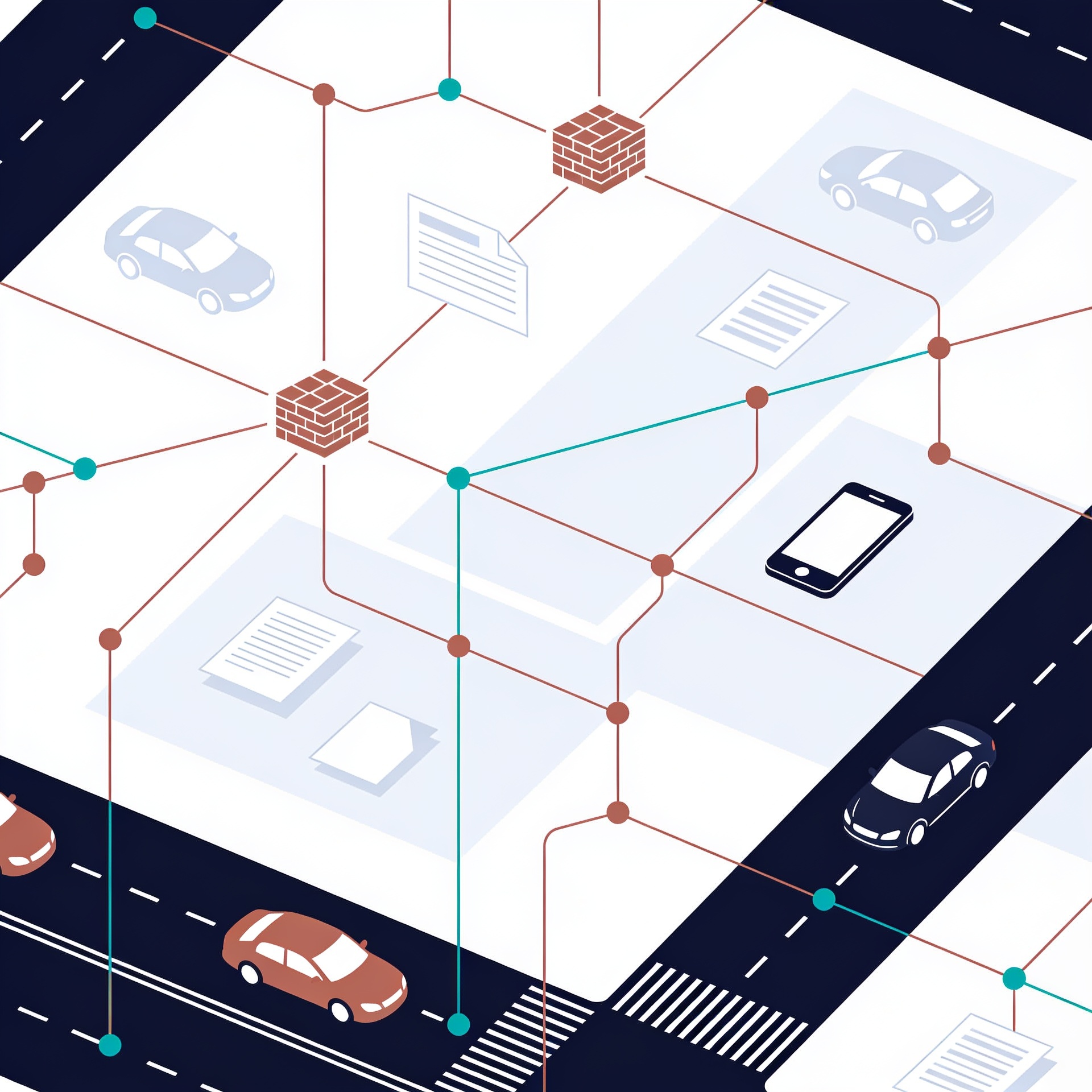
Approved repairer networks for auto insurers in Africa are usually built to negotiate better repair rates. The real return, however, comes from digitalizing the flow of quotes, invoices and photos between insurer, garage and expert, which shortens cycle times, tightens cost control and reduces fraud exposure across the claims book.
This page explains how these networks work in African markets, what makes a network genuinely digital rather than just a paper list of preferred garages, and what insurers and brokers should check before selecting a platform.
What is an approved (agréé/conventionné) garage network and how does it differ from free choice of repairer?
An approved, or 'agréé', garage network is a list of repairers that an insurer or broker has vetted and contracted with in advance, usually on price, turnaround time and workmanship standards. A 'conventionné' garage typically has a signed convention with the insurer covering billing terms, while a 'partner' garage may simply have an informal working relationship without a formal agreement. In practice, insurers in African markets use these terms loosely, and the distinctions matter mainly for how invoicing and pre-authorization are handled.
Free choice of repairer is a different question: can the insured send their car to any garage they want, even outside the approved list? In France, the 2014 Loi Hamon, codified at Article L211-5-1 of the Code des assurances, gives insureds this legal right even when an approved network exists, according to HASA Automobiles. No equivalent article has been confirmed in the CIMA Code des Assurances or in Morocco's insurance law, so the practical answer varies by country and by insurer contract. What is consistent across markets is that approved garages tend to offer faster processing and, often, no upfront payment by the insured, according to LeLynx.fr, which is the commercial incentive insurers use to steer volume toward the network rather than a legal obligation.
Why the distinction matters operationally
For claims teams, the practical difference is not the label but the workflow attached to it. A garage inside a digitally connected network can submit a quote, receive validation and get paid without a single physical document changing hands. A garage outside the network, even if technically 'approved' on paper, often still runs on phone calls, printed invoices and manual reconciliation.
Why do insurers and brokers in Africa build or expand approved garage networks?
The underlying pressure is claims cost growth outpacing premium growth. In the CIMA zone, insurers spent FCFA 91 billion on road accident victim compensation in 2017, up from FCFA 74 billion in 2013, a 22% increase in claims cost against 16% premium growth over the same period, according to Finactu. The CIMA zone also records around 45,000 road deaths per year, with a risk of dying on the road roughly 100 times higher than in Europe once adjusted for vehicle fleet size, per the same source. Against that backdrop, controlling the cost and quality of vehicle repairs is one of the few levers insurers can pull without touching pricing.
A second driver is trust. NAICOM has estimated that around 60% of motor insurance papers circulating on Nigerian roads may be counterfeit, according to nairaCompare, a figure that points to a broader documentation integrity problem that also touches claims files, quotes and repair authorizations. An approved network with digital, traceable documents closes part of that gap.
How does a digital garage network reduce repair costs and claims leakage by 10-15%?
Digitalization does not reduce cost by negotiating harder with garages. It reduces cost by removing the delays, duplicated work and undetected inflation that accumulate when quotes and invoices travel by phone, email attachment or paper. YourSmartFlow, which connects insurers, brokers, experts and garages on one platform, estimates a 10 to 15% reduction in claims burden for clients who move their approved network onto a digital pipeline, a company proof point rather than an independently audited industry figure.
The mechanism behind that kind of reduction is straightforward:
- Quotes are standardized, so line items are comparable across garages and easier to audit.
- Experts validate remotely, cutting the time a vehicle sits idle waiting for a physical inspection.
- Photos are captured with geolocation and timestamp, reducing disputes over what damage existed before repair started.
- Settlement can be triggered automatically once a file is complete, removing the manual handoffs where files typically stall.
A related, if not directly comparable, illustration of what digitalization does to a claims-adjacent process comes from Côte d'Ivoire. After ASACI digitalized auto insurance attestations in November 2022, the auto branch's turnover grew 26% from 2022 to 2023, from 87 to 110 billion FCFA, against an average 6% annual growth in the four prior years, according to FANAF and ASACI. Digitalization also helped raise the settlement rate of contested recourse claim files to 63% in 2023, up from 58% in 2022, while recourse indemnification rose from 4.8 to 7.9 billion FCFA over the same period. These figures concern attestations and recourse rather than garage networks specifically, but they show the same underlying pattern: removing manual steps from an insurance process changes both volume and settlement speed.
How are garage quotes and invoices digitalized, validated and paid without manual back-and-forth?
In a manual approved network, a garage typically writes a quote, sends it by hand or email, waits for an expert or claims handler to review it, corrects it if rejected, and resubmits, often more than once. Each round trip adds days to the file.
A digital pipeline compresses this into a single loop: the garage submits a structured quote through the platform, the expert reviews and validates it remotely, and the approved amount is fed straight into the insurer's or broker's claims system. Once the file is complete, invoicing follows the same structured format, and settlement can be initiated automatically via API rather than waiting for a claims handler to re-key figures. This is the specific capability YourSmartFlow offers to its 50-plus insurer and broker clients across five African countries, alongside a stated go-live timeline of four weeks.
What changes for each party
| Party | Manual network | Digital network |
|---|---|---|
| Insured | Calls or visits branch for updates | Tracks status via web, app or WhatsApp |
| Garage | Submits paper or emailed quotes, waits for approval | Submits structured quotes, gets faster validation |
| Expert | Travels to inspect, manually compares figures | Validates quotes and reports remotely |
| Insurer/broker | Manually reconciles invoices before paying | Settlement can trigger automatically once file is complete |
How do certified anti-fraud photos protect insurers when selecting and monitoring garages?
Photo evidence is the weakest link in most manual repair workflows, because photos sent by WhatsApp or email carry no proof of when or where they were taken, which makes it hard to distinguish pre-existing damage from new damage, or to confirm a repair actually took place as described. Guided capture with geolocation and timestamping, the approach used by WeProov, YourSmartFlow's technology partner, addresses this directly: the photo itself carries evidence of context, not just content.
For insurers running an approved network, this has a second use beyond fraud detection on individual claims. Aggregated across a garage's file history, certified photos become a monitoring tool: an insurer can see which garages consistently produce clean before/after documentation and which ones generate repeated disputes, and use that pattern when renewing or renegotiating network agreements.
How is glass breakage (bris de glace) handled differently within an approved network vs. standard claims?
Glass breakage is usually the simplest claim type an insurer handles, and it is often the first workflow insurers digitalize because the damage is easy to photograph, the repair is fast, and the cost is predictable. Within an approved network, a glass claim can be routed directly to a specialist repairer without a full expert inspection, since the damage type leaves little room for dispute.
Morocco offers a concrete illustration of how far this can go. Wafa Assurance advertises glass-breakage repair within 90 minutes, either at an approved garage or via a mobile repair unit on-site, according to a Wafa Assurance announcement. That kind of turnaround is only realistic when the claim declaration, garage assignment and invoicing are already digitally connected; a paper-based process cannot support a 90-minute promise. Standard claims involving collision or structural damage still require an expert's validation, which is where remote quote review adds the most value compared to a simple glass repair.
What does a CIMA-zone or Morocco-specific garage network look like today?
Morocco's market shows the most mature version of approved networks among African markets referenced here. RMA Assurance publishes a public online directory of its approved garages, searchable by city, covering Casablanca, Marrakech, Agadir, Fès, Meknès, Kénitra and other cities, according to RMA's own site. Wafa Assurance goes further, letting insureds select their approved garage directly through the My Wafa mobile app and request pre-authorization digitally, per a Wafa Assurance announcement. Average auto claim indemnification delays across major Moroccan insurers were estimated at roughly 30 to 55 days in 2026, with digitally-driven insurers citing the shortest delays, according to a market comparator site, Wafir.ma; these figures come from a commercial comparison source rather than the regulator and should be treated as indicative. Morocco's insurance regulator, ACAPS, has been pushing for digital traceability of auto claims since 2024 to reduce indemnification delays, which the same source puts at 30 to 60 days on average.
In the CIMA zone, network structures are less standardized and less publicly documented than in Morocco. Individual insurers in Côte d'Ivoire, Cameroon, Senegal and other member states maintain their own approved garage lists, but public, searchable directories comparable to RMA's are not common. This gap is itself informative: it suggests that CIMA-zone insurers building digital networks today have room to differentiate simply by making their network transparent and traceable to policyholders, rather than by negotiating deeper discounts with garages.
How long does it take to launch a digital approved garage network, and what ROI can insurers expect in year one?
Deployment timelines depend on how much of the insurer's or broker's existing claims workflow needs to be connected, and how many garages and experts need onboarding. As a reference point, YourSmartFlow states a four-week go-live for its platform, alongside an expectation of first-year return on investment for clients, built on the estimated 10 to 15% reduction in claims burden described earlier. These are company-stated figures rather than independently audited benchmarks, and insurers should validate them against their own claims data during a pilot before scaling to the full network.
A useful discipline for any insurer evaluating timeline and ROI is to pilot with a defined subset of the network, such as glass-breakage claims or a handful of high-volume garages, measure cycle time and dispute rate before and after, and only then decide on full rollout.
What should insurers and brokers ask before selecting a garage network platform in Africa?
A short set of questions separates a platform that will genuinely change claims economics from one that digitizes paperwork without changing outcomes.
- Does the platform connect all four parties to a claim, the insured, the insurer or broker, the expert and the garage, in one system, or does it digitalize only one leg of the process?
- Are garage quotes and invoices structured data, or scanned documents that still require manual re-entry?
- Are photos captured with verifiable geolocation and timestamp, or plain images with no evidential value?
- Can settlement be triggered automatically once a file is complete, or does every file still require a manual sign-off step that recreates the old bottleneck?
- Does the vendor have live deployments in African markets comparable to yours, with a stated go-live timeline and a way to measure ROI during a pilot?
- How does the platform handle claim types with different urgency, such as glass breakage versus collision, so that simple claims are not slowed down by the same process as complex ones?
Asking these questions during vendor selection, rather than after signing a contract, is what determines whether an approved garage network becomes a real cost and fraud control mechanism or stays a static list of preferred repairers.
Approved repairer networks for auto insurers in Africa will keep growing as claims volumes rise and regulators push for shorter indemnification delays. The insurers that benefit most will be the ones that treat the network as a digital pipeline connecting insured, garage, expert and insurer, not simply as a negotiated discount list. YourSmartFlow's platform, already used by more than 50 insurer and broker clients across five African countries, is one example of what that pipeline looks like in practice.
Frequently asked questions
Can an insured freely choose their repair garage even if the insurer has an approved network?
In France, the Loi Hamon, codified at Article L211-5-1 of the Code des assurances, gives insureds a legal right to choose their own repairer even when their insurer maintains an approved network, according to HASA Automobiles. No equivalent article has been confirmed in the CIMA Code des Assurances or in Morocco's insurance law, so the answer depends on each insurer's contract terms in those markets. In practice, approved garages usually offer faster processing and no upfront payment, which is the incentive insurers use to steer volume without imposing a legal restriction on choice.
How does a digitalized approved garage network actually reduce average auto claim cost?
It removes the delays and duplicated work created by manual quote review, paper invoicing and physical expert visits, which are the main sources of claims leakage rather than the garage's hourly rate itself. YourSmartFlow estimates a 10 to 15% reduction in claims burden for clients running quotes, invoices and photos through a single digital pipeline, a company figure that should be validated with a pilot on a client's own claims data. Faster remote validation by experts and automated settlement triggers are the two mechanisms most directly responsible for the reduction.
How can insurers verify that a garage quote or invoice is not inflated or fraudulent?
Structured, standardized quotes make line items comparable across garages, which makes unusual pricing easier to spot than on free-text paper quotes. Certified photos with geolocation and timestamp, such as those captured through WeProov's technology, provide evidence of the vehicle's condition before and after repair, reducing disputes about what damage was pre-existing. Aggregating this data across a garage's claim history also lets insurers monitor which repairers generate repeated pricing or documentation issues over time.
What criteria should be used to select and evaluate partner garages in Africa?
Insurers typically evaluate repair quality, turnaround time and pricing consistency, but in a digital network they should also assess whether a garage can submit structured quotes and certified photos rather than paper documents. Morocco's RMA Assurance, for example, publishes a public directory of its approved garages by city, which is itself a form of transparency criterion insurers can apply to their own networks. Ongoing evaluation should rely on data from completed claims, such as dispute rate and cycle time, rather than a one-time onboarding check.
How long does it take to deploy a digital approved-garage management platform?
Timelines vary with the number of garages, experts and existing systems that need to be connected, but YourSmartFlow states a four-week go-live for its platform across insurer and broker clients in five African countries. A pilot on a limited claim type, such as glass breakage or a subset of high-volume garages, is a practical way to validate timeline and ROI expectations before a full network rollout. Insurers should treat vendor-stated timelines as a starting point to confirm against their own operational readiness.
What is the difference between an 'agréé', 'conventionné' and 'partenaire' garage?
An 'agréé' garage has been formally vetted and approved by the insurer, usually against quality and pricing standards. A 'conventionné' garage has signed a specific convention covering billing terms, most notably direct invoicing to the insurer rather than the insured. A 'partenaire' garage typically has a less formal working relationship, which in practice means the label matters less than whether the garage is connected to a digital workflow for quotes, invoices and settlement.