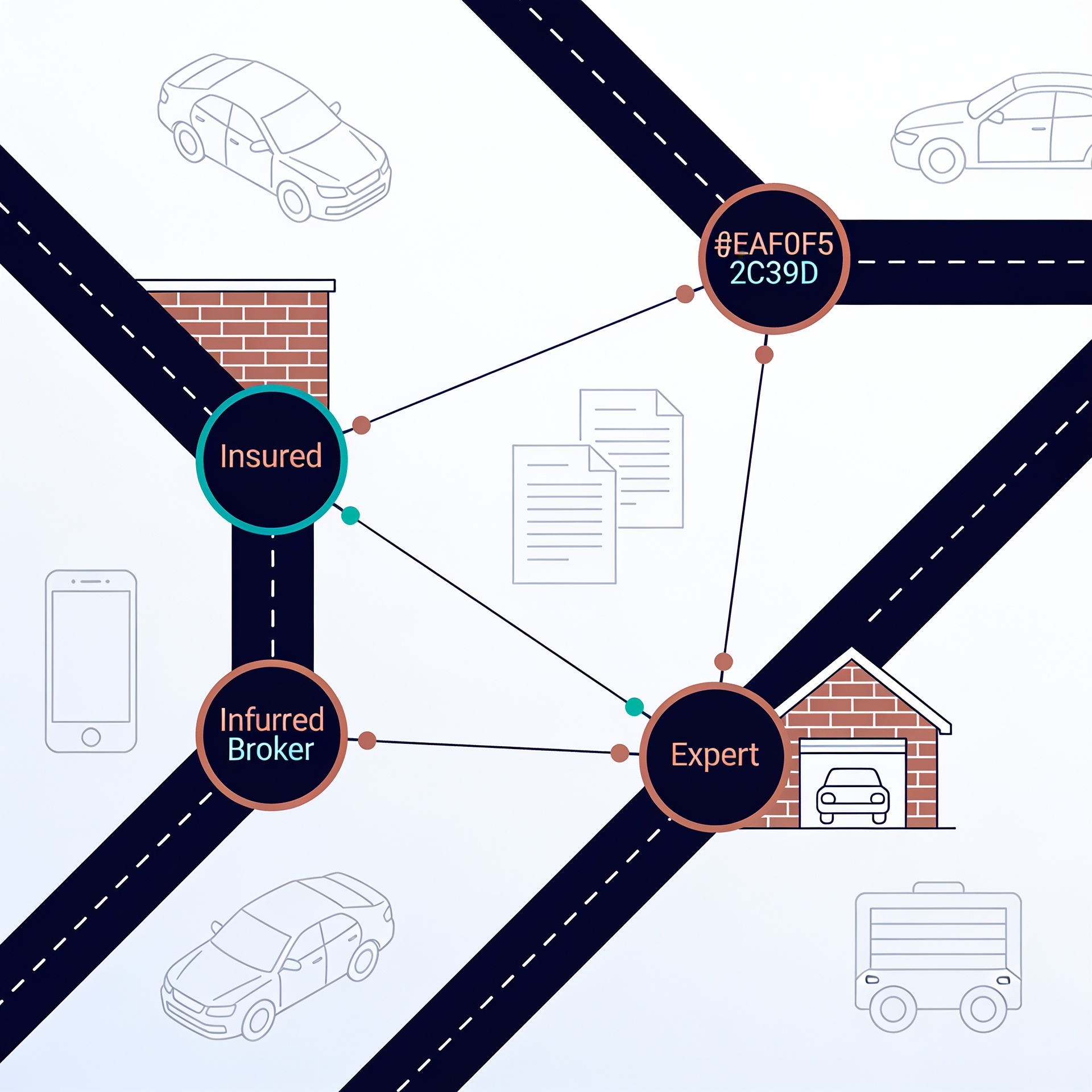
Auto insurance claims management software in Africa is a platform that connects the four parties of a motor claim, the insured, the insurer or broker, the expert and the garage, in one real-time workflow instead of a paper trail passed from desk to desk. It replaces manual handoffs with a shared digital file, tracked from first notice of loss to settlement. For insurers and brokers operating in CIMA member states, Morocco, Nigeria and Ghana, this is no longer an experimental idea; it is a practical response to chronic delays and unchecked fraud that regulators, brokers and policyholders all cite as the sector's biggest frustrations.
What Is Auto Insurance Claims Management Software in Africa, and Why Do Insurers Need It Now?
A claims management platform digitizes every step of a motor claim: declaration, document collection, expert validation, garage repair and settlement. It is not a generic case-tracking tool bolted onto existing spreadsheets. It is built around the specific documents and actors of an auto claim, the police report or accident statement, photos of damage, garage quotes, expert reports and the payment instruction.
The urgency is structural. The CIMA insurance market grew at an average annual rate of 8 percent over the past decade, yet it still represents only 3 percent of the African insurance market and 1.08 percent of the world market, according to the FANAF 2023 presentation of the CIMA-FinActu-Deloitte study. Insurance penetration in the CIMA zone stood at just 0.91 percent in 2021, against a population of roughly 191.5 million people, with premium density of only 13.1 dollars per capita, per the same study. Motor third-party liability, compulsory under Book II of the CIMA Insurance Code, generates most of the claims volume, which means inefficiencies in auto claims handling touch nearly every policyholder in the region.
At the same time, digital transformation in the zone is still described as nascent, or "balbutiante," by the same FANAF study, which points to four barriers: regulatory limits such as the legal validity of electronic signatures, technical and skills gaps, connectivity constraints, and a lack of institutional incentives for innovation. Software that is built for African connectivity conditions and regulatory realities, rather than imported unchanged from European markets, addresses these barriers directly.
What Are the Friction Points in the Traditional Auto Claims Journey in Africa?
The traditional journey is largely manual. A policyholder reports an accident by phone or in person, fills out a paper statement, and waits for a physical expert visit before a garage can even start repairs. Each handoff, insured to agent, agent to insurer, insurer to expert, expert to garage, introduces delay, lost documents and disputes over what was actually damaged.
In Morocco, this friction is visible in complaint data. ACAPS received 4,941 complaints in 2024, up from 4,767 in 2023, and motor insurance accounted for roughly two out of three of them, according to the FCB.ai analysis of the sector. Notably, 46 percent of these complaints were filed through lawyers rather than directly by policyholders, a strong signal that unresolved friction escalates into litigation rather than being caught early. Despite premium growth, insurance penetration in Morocco actually slipped slightly, from 3.8 percent to 3.7 percent in 2024, suggesting that market growth is not translating into a better claims experience for policyholders.
Across the wider CIMA zone, there is also widespread confusion among policyholders about what motor liability insurance actually covers, since legally it protects third parties and not the insured driver's own injuries, vehicle theft or fire, per the FANAF study. This misunderstanding, combined with slow manual processing, is a recurring source of disputes and reputational damage for insurers and brokers alike.
The Cost of Standing Still
International benchmarks cited in the FCB.ai analysis of the Moroccan market suggest that end-to-end digitization of the claims journey can cut overall costs by 15 to 20 percent and claims handling costs specifically by 25 to 30 percent. One cited US insurer reduced status-check calls by more than half after introducing a digital tracking tool. These figures are not African-specific, but they illustrate the scale of savings available to insurers still relying on manual claims handling.
How Does Claims Digitization Work in Practice?
A digitized claims workflow connects four actors on one shared file:
- The insured declares the accident through web, mobile app or WhatsApp, and can track the file's progress at every stage without calling an agent.
- The broker or insurer pilots the file from a single dashboard, assigning experts and garages, and monitoring where each claim sits in the pipeline.
- The expert reviews photos, quotes and reports remotely, validating or challenging figures without necessarily traveling to the vehicle.
- The garage submits repair quotes, invoices and time-stamped before and after photos directly into the same file.
Because all four parties work from the same record, there is no re-keying of data between systems and no version of the file that only one party can see. This is the core operational shift: claims management stops being a relay race between disconnected offices and becomes a single, auditable workflow.
Where API Automation Fits
Once a claim file is complete, meaning the declaration, the validated expert report and the garage's final invoice are all present, settlement can be triggered automatically through an API connection to the insurer's payment or core system. This does not remove human oversight from complex or contested files; it removes the administrative delay on the large share of claims that are straightforward and fully documented.
What Do Remote Expertise and Certified Anti-Fraud Photos Add to File Reliability in the CIMA Zone?
Remote expertise, often called EAD (expertise à distance), allows a qualified expert to validate damage assessments and garage quotes without a physical site visit for every case. Combined with guided photo capture that records geolocation and a timestamp at the moment the photo is taken, it becomes far harder to submit recycled, unrelated or manipulated images as evidence of damage.
WeProov, the technology partner behind this certified photo capture used by YourSmartFlow, reports processing more than 300,000 claims in 2024 through its AI-powered anti-fraud photo tool, with client-reported results including cost reductions of up to 50 percent on remote-expertise fees, a 10 percentage point increase in redirection to approved repair networks, and roughly 30 minutes saved per claims handler per file, according to WeProov's own published figures. These are self-reported outcomes, largely from French-market clients, so insurers evaluating similar tools in Nigeria, Ghana or the CIMA zone should treat them as an indication of potential rather than a guaranteed local result.
For insurers in markets where document fraud and inflated garage quotes are a known cost driver, certified, geolocated, time-stamped photos give claims handlers and experts an objective basis for validating or disputing a file, which reduces both fraud losses and disputes over legitimate claims.
What Regulation Applies, and Does It Really Hold Back Innovation?
Regulation is often assumed to be the main obstacle to digitizing claims in Africa. The evidence suggests a more nuanced picture.
In the CIMA zone, motor third-party liability is compulsory under Book II of the CIMA Insurance Code, alongside cargo insurance for imports and professional liability for insurance intermediaries, per the FANAF 2023 study. The regulatory framework for the claim itself, meaning who must be notified and within what timeframe, has not fundamentally changed with digitization; software simply executes these existing obligations faster and with a clearer audit trail.
Morocco offers a concrete example of regulation actively enabling digital claims handling rather than blocking it. Decree 2-23-746, dated 9 January 2024, authorizes insurance intermediaries such as brokers and agents to carry out ancillary activities including claims management on behalf of third parties, according to the FCB.ai analysis. Morocco's instruction P.IN.02/2022 on online insurance sales, effective from 1 July 2022, relies on law 53-05 as amended by law 43-20, which introduced a third level of electronic signature, allowing contracts to be concluded fully remotely. The national database of insured vehicles, known as RNVA, went into production in July 2025, and the E-Constat digital accident report app, launched in January 2022, has received more than 20 updates, both signals of active regulatory infrastructure investment rather than resistance.
The FANAF study's own diagnosis is more balanced than a simple "regulation blocks innovation" narrative: it names regulatory limits as one of four barriers, alongside technical and skills gaps, connectivity constraints, and weak institutional incentives for innovation. In practice, platforms designed around existing legal frameworks, rather than waiting for new laws, are the ones moving fastest.
Regulatory Snapshot
| Market | Key claims-relevant rule | What it enables |
|---|---|---|
| CIMA zone | Motor RC liability compulsory, CIMA Insurance Code Book II | Baseline claims volume and notification obligations are already codified |
| Morocco | Decree 2-23-746 (Jan 2024) | Brokers and agents can manage claims on behalf of third parties |
| Morocco | Law 53-05 amended by 43-20, instruction P.IN.02/2022 | Third-level electronic signature permits fully remote contracting |
What Measurable Results Can Insurers Expect?
Insurers and brokers evaluating a digital claims platform typically look at four metrics: settlement time, fraud exposure, cost of claims handling, and return on investment.
On cost of handling, benchmarks cited in the Moroccan market analysis point to a 15 to 20 percent reduction in overall claims costs and 25 to 30 percent in handling costs specifically when the journey is digitized end to end, according to FCB.ai's summary of international studies. YourSmartFlow's own client data across its deployments points to an estimated 10 to 15 percent reduction in claim burden, with insurers and brokers typically reaching return on investment within the first year. As of 2025, the platform has processed more than 250,000 auto claims across more than 50 insurer and broker clients in five African countries, with new clients typically live within four weeks of contract signature. These figures come from YourSmartFlow's own reporting and should be read as a track record to discuss with the vendor directly, rather than an independently audited benchmark.
On fraud, certified photo capture and remote expertise validation are the two levers most directly tied to reducing manipulated or recycled evidence, as covered in the previous section. On funding and market momentum, African assurtechs raised 144.7 million dollars in 2021, a year-on-year increase of more than 200 percent, against a global assurtech funding record of 15.8 billion dollars the same year, according to the FANAF study. This shows investor appetite for the category, even if the CIMA zone's own digital claims adoption data remains limited in public reporting.
Insurtech or Assurtech: What Is the Difference, and Where Does a Platform Like YourSmartFlow Fit?
The two terms are often used loosely. "Insurtech" is the broader English-language term covering any technology applied to insurance, from pricing algorithms to distribution apps. "Assurtech" is the term more commonly used in francophone African markets and tends to be applied specifically to technology vendors serving insurers and brokers, rather than technology built by insurers themselves or by consumer-facing comparison sites.
Within this landscape, a claims management platform such as YourSmartFlow sits in a specific and narrower category: it is not a pricing engine, a distribution app or a comparison site. It is operational infrastructure that connects the insured, the insurer or broker, the expert and the garage around one claim file, from declaration to settlement. This distinction matters for buyers, since a claims workflow platform is evaluated on integration with existing core systems and expert or garage networks, not on actuarial modeling capability.
How to Digitize Claims Management in Morocco and Francophone West Africa, Step by Step
A realistic rollout sequence looks like this:
Step 1: Map the Current Claims Journey
Document every handoff in the existing process, from first notice of loss to payment, including which party currently holds each document and how long each step typically takes. This baseline is what proves the value of digitization later.
Step 2: Digitize First Notice of Loss
Give the insured a way to declare a claim by app, web form or WhatsApp, with photo capture guided to meet the evidentiary standard experts and insurers require. This single change removes the earliest and most common point of delay: waiting for a paper statement to physically reach the insurer.
Step 3: Connect Experts and Garages to the Same File
Rather than sending documents by email between separate systems, bring experts and garages into the same digital file so quotes, reports and photos are validated in place, with a visible audit trail.
Step 4: Automate Settlement for Complete Files
Once a file meets defined completeness criteria, route it for automatic settlement via API rather than manual re-entry into the payment system, reserving manual review for complex or contested cases.
Step 5: Track and Report
Measure settlement time, complaint volume and fraud flags against the baseline from Step 1. In Morocco specifically, this data is also useful for demonstrating compliance intent to ACAPS given the current volume of motor-related complaints noted earlier.
How to Choose and Deploy a Claims Management Platform in Africa
Insurers, brokers and fleet managers evaluating vendors should weigh a short list of practical criteria rather than feature checklists alone.
- Time to go live. A platform requiring months of custom integration before the first claim can run through it delays the value it is meant to deliver. A four-week go-live benchmark, as offered by YourSmartFlow, is a reasonable target to hold vendors to.
- Coverage of all four claim parties. A tool that only digitizes the insurer's internal dashboard, without connecting the insured, the expert and the garage, will not remove the handoff delays described earlier in this article.
- Anti-fraud evidence quality. Confirm whether photo capture includes geolocation and timestamping, and whether remote expertise validation is supported, since these are the two features most directly tied to reducing document fraud.
- Fit with local regulation. Confirm the platform's approach to electronic signature and data protection aligns with the specific rules in your market, whether that is Morocco's law 53-05 as amended, CIMA Code provisions, or Nigerian and Ghanaian data protection requirements.
- API readiness for automated settlement. Ask whether settlement can be triggered automatically once a file is complete, and what happens to files that fail completeness checks.
Fleet managers and self-insured corporates should apply the same criteria but pay particular attention to garage network coverage, since claims volume for a commercial fleet is concentrated and repair turnaround time has a direct operational cost.
Conclusion
Auto insurance claims management software in Africa is best understood as operating infrastructure, not a transformation slogan. It addresses two concrete, well-documented problems, slow settlement and unreliable evidence, by connecting the insured, the insurer or broker, the expert and the garage on one real-time file, and by giving claims handlers certified, time-stamped photo evidence instead of unverifiable paperwork. Regulation in Morocco and the CIMA zone is, on the evidence reviewed here, adapting to support this shift rather than blocking it. Platforms such as YourSmartFlow illustrate what this looks like in practice for insurers and brokers who want measurable results within a single fiscal year rather than a multi-year technology program.
Frequently asked questions
What is auto claims management software and how does it differ from a simple internal tracking tool?
Claims management software connects the four parties to a motor claim, the insured, the insurer or broker, the expert and the garage, on one shared file, from declaration through settlement. A simple internal tracking tool only follows the status of a file on the insurer's side, without giving the insured, the expert or the garage direct access to submit photos, quotes or reports. This difference is what actually removes the delays caused by exchanging documents between separate parties.
Is remote claims declaration and management legally valid in the CIMA zone and Morocco?
In Morocco, law 53-05 as amended by law 43-20 introduced a third level of electronic signature, which allows contracts to be concluded and, within that framework, claims to be managed remotely, according to the FCB.ai analysis. Decree 2-23-746 of 9 January 2024 also authorizes insurance intermediaries to manage claims on behalf of third parties. In the CIMA zone, notification obligations and timeframes remain those set by the CIMA Insurance Code; digitization does not change the legal framework, it simply speeds up how it is executed.
How long does it take to deploy a claims management platform in Africa?
Timelines vary depending on the complexity of integration with an insurer's or broker's existing systems, but a four-week go-live for the initial deployment is a realistic target, as offered by YourSmartFlow. Later steps, connecting experts and garages and then automating settlement through an API, can extend over several months depending on scope.
What is the actual return on investment from digitizing auto claims?
Market benchmarks cited by FCB.ai from international studies point to a 15 to 20 percent reduction in overall claims costs and 25 to 30 percent in handling costs when the journey is digitized end to end. YourSmartFlow reports, based on its own deployments, an estimated 10 to 15 percent reduction in claims burden, with return on investment typically reached within the first year. These figures should still be assessed case by case against each insurer's or broker's own context.
What is the difference between insurtech and assurtech, and where does a platform like YourSmartFlow fit?
Insurtech is the broad term for any technology applied to insurance, while assurtech is more commonly used in francophone African markets to describe technology vendors serving insurers and brokers. A platform like YourSmartFlow sits in a specific category within this landscape: operational claims management infrastructure, distinct from pricing engines or consumer-facing comparison sites.
How do remote expertise and certified anti-fraud photos protect against disputes and document fraud?
Certified photos, geolocated and timestamped at the moment of capture, make it far harder to submit recycled images or photos unrelated to the declared claim. Remote expertise allows a qualified expert to validate quotes and reports without a systematic site visit, relying on this objective photographic evidence. WeProov, YourSmartFlow's technology partner, reports cost reductions of up to 50 percent on remote-expertise fees among its clients, a self-reported result that should be confirmed against the specific market.